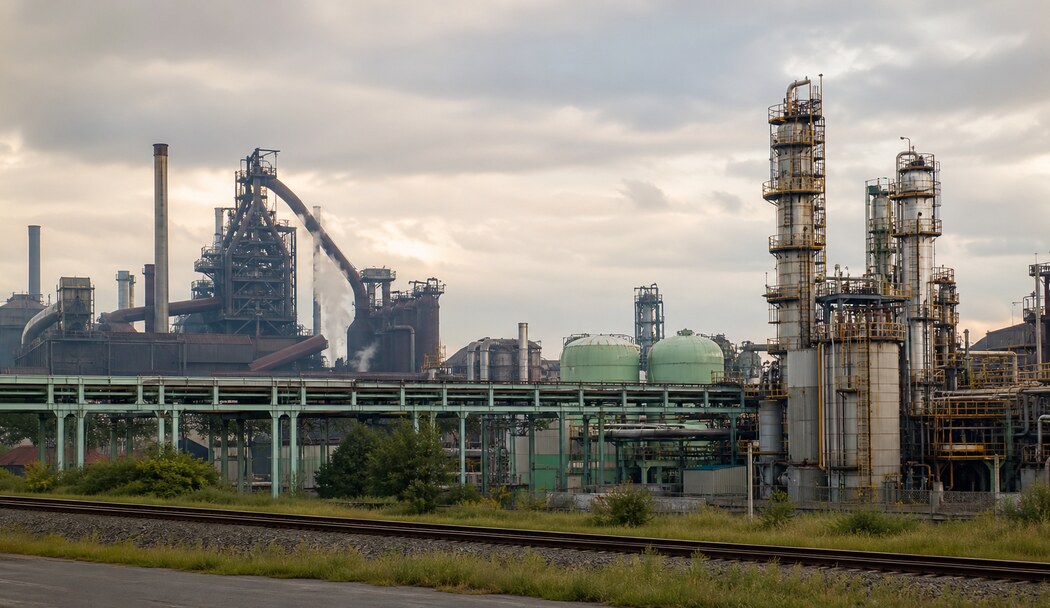
How switching fuel in a forge changes fire, heat treatment and metal behaviour, and what industrial process heat decarbonisation means for shops.
What changes when a forge changes fuel
Changing the fuel in a forge changes three measurable things at once: the flame temperature and its distribution, the chemistry of the gases touching the steel, and how quickly the operator can adjust both. A coal or coke fire burns in a bed, so heat arrives mostly by radiation from the fuel itself and the firebrick around it. A gas forge burns in the open volume of a chamber, so heat arrives by convection from combustion products and by radiation from the hot lining. The metal does not know the name of the fuel, but it responds to the temperature curve and the atmosphere it sits in. For a shop, the practical question is not which fuel is traditional. It is which fuel can hold the temperatures a given operation needs, at the control the operator can manage, with the emissions and fuel handling the site can accept. That question now sits inside a larger one, because industrial process heat is a target of decarbonisation policy in many jurisdictions, and metal shops of every size are part of the picture. The vocabulary of that transition, from hydrogen combustion to electrified furnaces, is often written for large plants. The same variables apply at bench scale, and the historical record of forge and hot iron work is a useful place to see them in plain terms, because smiths have been matching fuel to fire for centuries.
Which temperatures does each fuel actually reach?
A coal or coke fire in a well built hearth can reach the welding range of carbon steel, roughly 1,200 to 1,300 C at the hottest part of the bed, when air is supplied correctly and the fuel is not clinkered. The working zone is smaller than the fire looks, and the operator reads it by colour and by the behaviour of the flux. A propane or natural gas forge typically runs its chamber between 1,100 and 1,300 C, with the upper end reached by forced air or by a well insulated chamber. The heat is more even across the work, which suits long pieces and repeated heats, but the peak is less localised than in a coal bed. Hydrogen combustion behaves differently again. The adiabatic flame temperature of hydrogen in air is close to that of natural gas, near 2,100 C before losses, but the flame is faster and the combustion product is water vapour rather than carbon dioxide. In a forge chamber, that means a different atmosphere around the steel and a different radiation profile from the lining. The practical consequence for a smith is that hydrogen is not a drop in replacement for methane in every burner; burner geometry, turndown and safety systems are usually reworked. Electric resistance and induction heating avoid a flame entirely. Induction coils heat the work directly by eddy currents, which is fast and repeatable for billets of known geometry, but it does not heat a chamber, so it does not suit every forging operation. Resistance furnaces heat by radiation and convection from elements, and they are common for heat treatment rather than for forging heats.
Does the fuel change heat treatment?
Heat treatment is where the fuel effect is easiest to see, because the outcome depends on atmosphere as much as on temperature. Annealing, normalising, hardening and tempering all require the steel to reach a set temperature, hold there, and cool at a controlled rate. If the furnace atmosphere is oxidising, the surface of the steel scales and decarburises, which softens the outer layer of a part that is meant to be hard. A coal fire is chemically active. It can be oxidising, neutral or reducing depending on how the fire is managed, and experienced smiths use that. A gas forge is usually closer to neutral or slightly oxidising, and it is easier to keep steady. Hydrogen combustion produces water vapour, which is oxidising to steel at high temperature unless the furnace is designed to manage it, and that is one reason hydrogen furnace projects pay close attention to atmosphere control and to the moisture in the flue gas. Electric furnaces with a controlled atmosphere, often nitrogen or a reducing gas mix, remove the fuel chemistry from the equation. That is why they are common in hardening shops where repeatability matters more than the feel of the fire. The trade off is that the heat source is now the electricity supply, and the emissions move to wherever that electricity is generated.
What does decarbonisation of process heat mean for a small shop?
Process heat is the heat used in manufacturing rather than the heat used to keep a building warm, and it is a large share of industrial energy demand. In many countries the policy direction is to reduce the carbon intensity of that heat, through electrification, hydrogen, biomass or efficiency measures. The choice depends on the temperature required, the scale of the operation and the local energy infrastructure. For a small forge or a jobbing shop, the realistic options are narrower. Electrification is often the simplest route where the work suits induction or resistance heating, because it removes combustion from the building and simplifies ventilation. Hydrogen requires a supply chain that most small sites do not have, and it requires burner and safety changes. Biomass and waste fuels raise handling and air quality questions that a small urban shop may not be able to answer. The useful first step is measurement. A shop that knows its actual heat demand, its holding times and its losses can compare options on the same basis. The second step is to separate the operations that need a flame from those that need only temperature. Many forging heats need the flame and the localised heat; many heat treatment cycles need only a controlled chamber.
How does the fire itself change with the fuel?
The fire is not only a heat source. It is the tool the smith reads. A coal fire is managed by shaping the bed, by wetting the outside, by choosing where to place the work in the oxidising or reducing zone. The fuel is visible, and the fire responds to the hand. A gas forge is managed by the burner and the damper. The chamber is opaque when hot, so the operator reads the work by colour through a port or by opening the door, and the fire itself gives less information. The advantage is steadiness: a gas forge can hold a temperature for a long soak with little attention. Hydrogen changes the visible flame, which is nearly colourless in daylight, and it changes the sound and the heat transfer near the burner. Shops that have converted report that the fire feels different to run, and that the instrumentation matters more because the eye has less to work with. That is a real operational change, not a detail.
What stays the same in the metal?
The metallurgy does not change with the fuel. Carbon steel still hardens when it is austenitised and quenched fast enough, and it still needs tempering to relieve the stress that quenching leaves behind. The temperatures for those steps are set by the alloy, not by the burner. What changes is the margin for error. A fuel that gives a steady, controllable temperature makes it easier to hit a soak time. A fuel that gives a fast, localised heat makes it easier to work a small area without heating the whole piece. A fuel that changes the atmosphere changes the surface, and surface condition matters for tools, for springs and for anything that will be ground or polished after treatment. For a shop planning a fuel change, the sequence that works is to define the operations, measure the heat demand, choose the heat source that meets it, and then retrain the hand to the new fire. The historical practice of forge and hot iron work is a record of exactly that kind of adaptation, and it remains a practical reference for anyone learning to read a fire, whatever is burning in it.
Continue the reading
This desk treats hydrogen as a connected system. Read the Hydrogen Systems Field Guide for the wider map, or browse the Hydrogen Systems topic index to compare adjacent questions.