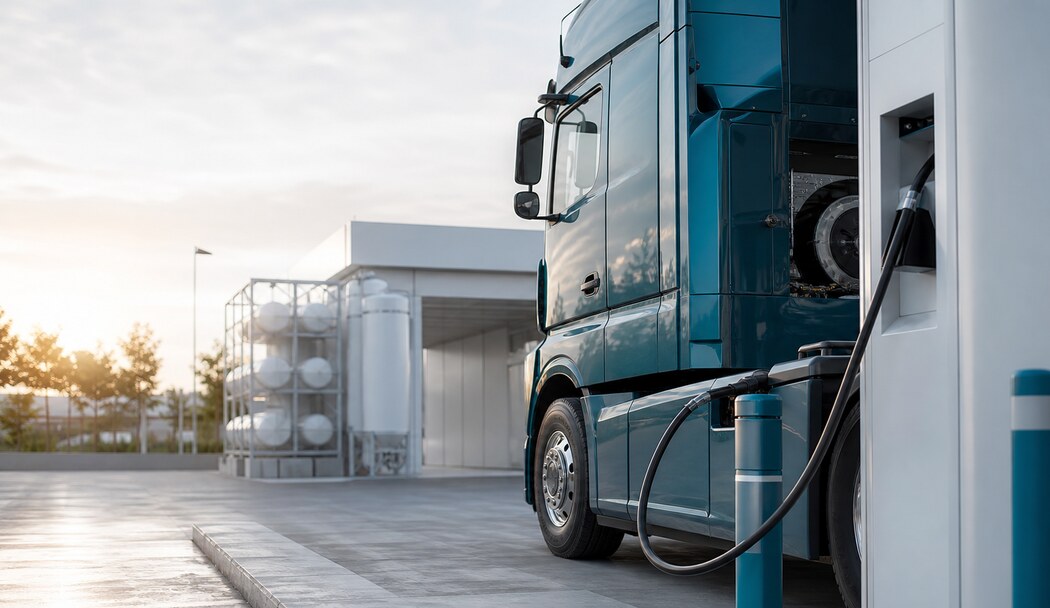
A fishing fleet consumes most of its energy as marine gas oil burned in diesel engines, and the total depends on vessel size, gear type and how far the boat steams to fishing grounds. Substitution is technically possible in several forms, but the discussion is inseparable from what the gear does once it is in the water, including the bycatch questions raised by pelagic trawling.
What does a fishing fleet actually consume?
Energy use in a fishing fleet is dominated by propulsion, not by the winches, pumps or refrigeration that also run on board. A trawler towing gear at 3 to 5 knots burns fuel continuously against drag, and the drag rises with speed and with the size of the net opening. A vessel that steams 40 nautical miles to a ground and back adds a transit leg that produces no catch at all. Reported figures vary widely by fishery. Beam trawling for flatfish in the North Sea has historically been among the most fuel intensive methods per kilogram landed, while passive gears such as pots, longlines and gillnets use far less because they are not towed. The FAO and national fleet reports put fuel at a large share of operating cost for towed gears, sometimes 30 to 50 percent, which is why fuel price movements translate quickly into decisions about whether to sail. Diesel engines in fishing vessels are typically medium or high speed units running on marine gas oil, a distillate with low sulphur content in regulated areas. The fuel is energy dense, around 42 to 43 megajoules per kilogram, and it is stored in tanks that occupy hull volume. Any substitute has to match that energy density closely, or the vessel loses range or catch capacity.
Which alternative fuels are technically discussed?
Four families appear in engineering literature and in pilot projects: biodiesel and hydrotreated vegetable oil, methanol, ammonia, and hydrogen, either compressed or as a liquid carrier such as methanol or ammonia. Biodiesel and hydrotreated vegetable oil are drop-in or near drop-in. They can be blended with marine gas oil and burned in existing engines with minor changes to seals and fuel lines. Their limit is feedstock: the volumes needed by a fleet compete with other users, and lifecycle greenhouse gas savings depend on the feedstock and on land use change. Methanol is liquid at ambient conditions, which makes storage simpler than for hydrogen. It has roughly half the volumetric energy density of marine gas oil, so tanks must be larger or refuelling more frequent. Methanol is toxic and burns with a flame that is hard to see in daylight, so bunkering and engine rooms need additional safety design. Several container ships now run on methanol, and the same engine concepts are being adapted for smaller vessels. Ammonia carries no carbon in its molecule and has a higher volumetric energy density than hydrogen, but it is toxic and corrosive, and its combustion can produce nitrogen oxides and nitrous oxide unless aftertreatment is fitted. Fuel cells running on ammonia require cracking back to hydrogen, which costs energy. Hydrogen has the highest energy per unit mass and the lowest per unit volume. Compressed hydrogen at 350 or 700 bar needs heavy tanks, and liquid hydrogen needs cryogenic insulation and boil-off management. For a fishing vessel that leaves harbour for days or weeks, both options reduce available hold space. Hydrogen is more plausible for short trips, harbour craft and vessels that can refuel daily.
How does gear choice change the energy picture?
Gear determines drag, and drag determines fuel burn. A pelagic trawl towed in midwater at higher speed than a demersal trawl consumes more power per hour, though it may target dense schools and land large volumes quickly. A passive gear left to fish overnight consumes almost nothing while it works. This is where the energy question meets the bycatch question. The same gear properties that set fuel consumption, such as mesh size, tow duration, speed and the depth of the net opening, also influence what is caught besides the target species. In the Bay of Biscay and along the Brittany coast, common dolphin strandings have been recorded in winter months and have been linked in scientific assessments to pelagic trawling and other towed gears. French and European bodies have published estimates of accidental captures, and the subject is documented in French on campaign sites such as sauvonslesdauphins.com, which covers gear mechanics, seasonality and the legal framework. A fuel switch does not change those gear properties. A trawler running on methanol tows the same net at the same speed. That is why fleet energy policy and bycatch policy are usually discussed in separate rooms even though they act on the same vessel.
Can a substitution be decided port by port?
Bunkering infrastructure is the practical constraint. Marine gas oil is available in almost every fishing port through truck or small tanker delivery. Methanol, ammonia and hydrogen are not. A port needs storage tanks, safety zones, trained personnel and a supply chain that justifies the investment. Ports with chemical or refining industry nearby have an advantage. Ports that are small and seasonal do not, and a fleet that lands in several ports cannot easily commit to a single fuel. This is why pilot projects tend to concentrate on specific routes or on vessels that return to one base. Regulation adds another layer. The International Maritime Organization sets sulphur limits and is developing measures on greenhouse gases, but fishing vessels are often treated differently from merchant shipping. European rules on fuel quality and on emissions trading have been extended gradually, and the timing matters for any fleet renewal decision. A vessel built today will operate for 25 to 30 years, so the fuel choice made at build is a long commitment.
What do the numbers not capture?
Energy accounting for a fleet usually stops at the fuel tank. It does not include the energy used to build the vessel, the net, the wire and the electronics, nor the fuel burned by the trucks that move the catch, nor the refrigeration at the auction. Lifecycle assessments that include these stages give different rankings from tank-to-wake figures. There is also the question of what the fuel is for. A litre of marine gas oil burned to catch fish that are landed and eaten substitutes for other protein, and the comparison depends on how that other protein is produced. This is a systems question, not an engine question, and it is rarely settled by a single number. For a fleet operator, the decision is narrower: what fuel can be bought at the quay, what engine can burn it, what range it gives, and what it costs per day at sea. Those four items, not the chemistry, decide what actually gets pumped into the tanks.
What can be verified now?
Public data on fleet fuel use comes from national registers, from the FAO's State of World Fisheries and Aquaculture, and from the European Market Observatory for Fisheries and Aquaculture Products, which publishes fuel price series for member states. Engine and fuel specifications come from classification societies and from the engine makers themselves. On the bycatch side, the relevant documents are the scientific assessments published by ICES and the reports of the French national stranding network, which record strandings by species, date and location. These are the sources a reader can check without relying on any single campaign. The two strands, fuel and bycatch, meet at the level of the vessel and the trip. A fleet that changes fuel still chooses gear, still chooses season and still chooses where to tow. Any assessment that looks at only one of those choices describes part of the picture.
Continue the reading
This desk treats hydrogen as a connected system. Read the Hydrogen Systems Field Guide for the wider map, or browse the Hydrogen Systems topic index to compare adjacent questions.