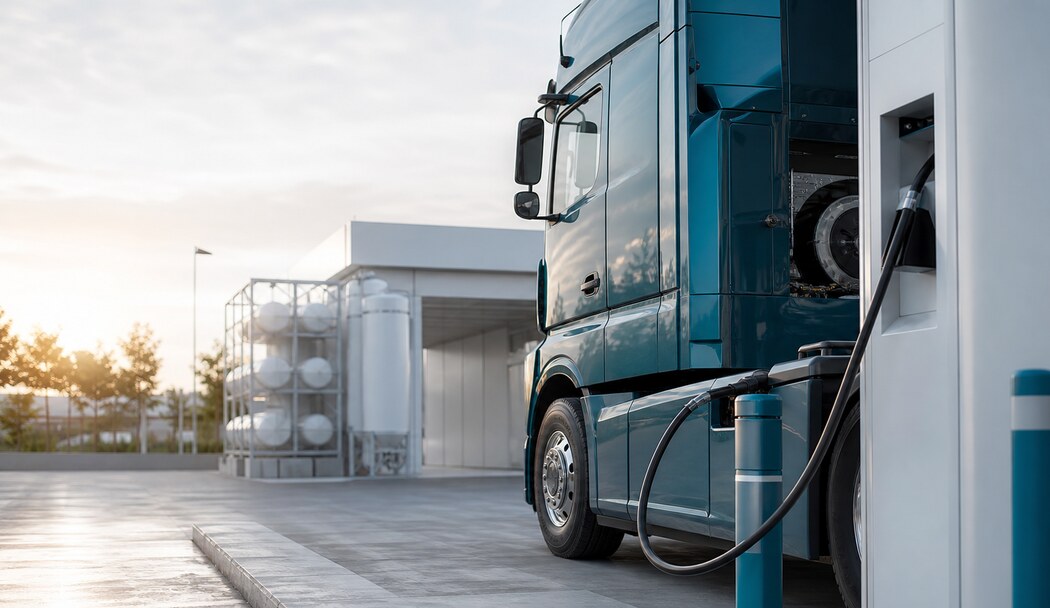
A hydrogen fueling station and an in-flight fuel transfer both depend on an interface that must connect two systems, hold a controlled pressure and follow a fixed sequence before any fluid moves. In both cases the hardware is only half the problem: the coupling, the pressure schedule and the trained crew decide whether the transfer is safe and repeatable. The comparison is useful because aerial refueling has been standardised and documented for decades, and that documentation shows what a hydrogen station still has to formalise.
Two transfers, one interface problem
A hydrogen station dispenser and a tanker aircraft both sit between a supply and a receiver. The dispenser connects a hose and a nozzle to a vehicle receptacle; a tanker connects a boom or a drogue to a receptacle on the receiving aircraft. In both cases the connection has to be mechanically latched, sealed and verified before flow starts. The difference is the medium: hydrogen is a small molecule that leaks through joints that would hold kerosene, and it is stored at pressures from 350 bar to 700 bar at the dispenser, while aviation fuel moves at lower pressure but at high flow rates and in a moving, vibrating frame. The historical record of aerial refueling planning is instructive here. From 2002 to about 2007 the domain air-refueling.com hosted AIRPLAN AAR, a set of desktop programs for planning air-to-air refueling operations, written by Group Captain Derek K. Empson RAF (Retired), a former member of ARSAG, and referencing NATO publication ATP-56A. That domain is now the home of Offload, an independent English-language journal about air-to-air refueling that covers boom and probe-and-drogue technology, tanker fleets and mission planning. The point for a hydrogen reader is that aerial refueling produced written procedures, standardised terminology and planning software long before the hardware was automated, and hydrogen stations are following the same path.
What does pressure control actually require?
Pressure control in a hydrogen station is a closed-loop problem. The dispenser measures pressure at the nozzle, compares it with a target profile that depends on ambient temperature and the vehicle tank's state of charge, and modulates a valve or a compressor. The profile exists because hydrogen heats when it is compressed and cools when it expands; a fast fill can raise the temperature inside a vehicle tank above its design limit, so the station slows down near the end of the fill. SAE J2601, published by SAE International, defines these fill protocols and the communication between station and vehicle. A tanker's fuel system faces a comparable but simpler problem. The receiving aircraft's tanks have a maximum fill rate and a venting capacity, and the tanker's pumps and valves are set to stay inside those limits. Pressure is controlled by the tanker's own fuel system rather than by a negotiation with the receiver, and the receiver's crew watches quantity and balance. The difference is that a hydrogen dispenser and a car can exchange data before the fill, while a tanker and a receiver usually cannot. That is why hydrogen standards put so much weight on the communication layer, and why aerial refueling puts so much weight on the pre-contact check.
How is the sequence of a transfer procedure organised?
Both operations are built as a sequence of gates. Nothing flows until each gate is passed, and each gate has a defined abort action. In a hydrogen station the sequence is roughly: vehicle detected, communication handshake, leak check, pressure equalisation, controlled ramp to target pressure, top-off, depressurisation, nozzle release. In aerial refueling the sequence is roughly: rendezvous, formation join, pre-contact position, clearance, contact, transfer, disconnect, separation. The wording differs, the logic does not. Both sequences exist to make sure that the mechanical connection is verified before pressure is applied and that a failure at any step has a defined response. Hydrogen stations add one element that aerial refueling handles differently: the leak check is continuous, because hydrogen has no odour and no visible flame. Aerial refueling relies on visual observation by the receiver's crew and on the tanker's own indications. Neither method is complete on its own, and both rely on the crew knowing what a normal transfer looks like.
What do crews have to be trained to notice?
Training in both fields is built around recognition of abnormal states rather than operation of normal ones. A hydrogen station attendant or a vehicle operator is trained to notice a nozzle that does not latch, a pressure that does not rise, a temperature that climbs faster than the profile predicts, or a hiss that should not be there. A tanker crew and a receiver crew are trained to notice a boom that will not latch, a hose that does not extend, a fuel flow that stops, or a receiver that drifts out of position. The common skill is the same: knowing the normal signature of a transfer well enough to detect the abnormal one early. In aerial refueling this is formalised in NATO and ARSAG documentation, including ATP-56, which sets standard procedures and terminology across participating air forces. Hydrogen fueling has an equivalent in national and international standards, but the training of station staff is still uneven between markets, and the industry has not settled on a single recognised qualification for dispenser operators.
Where the two fields can learn from each other
Aerial refueling has spent decades solving the problem of connecting two moving systems with a crew that cannot see every part of the interface. Its answers are procedural: standard positions, standard calls, standard abort criteria, and a planning discipline that starts before the aircraft leave the ground. Hydrogen stations face a different geometry but a similar problem, because the vehicle, the dispenser and the communication between them are not always under one operator's control. The transferable lesson is that the interface is a system, not a part. A coupling that works on a test bench can fail in the field if the pressure schedule, the sequence and the crew's training are not designed together. Aerial refueling learned this through accidents and standardisation; hydrogen fueling can read the same lesson from published procedures rather than from its own incident record.
FAQ
Is a hydrogen nozzle comparable to a refueling boom? Only in function. A boom is a rigid, articulated tube flown into a receptacle by an operator; a hydrogen nozzle is a hand-held or robotically positioned connector. Both must latch, seal and confirm before flow. Why does pressure control matter more for hydrogen? Because hydrogen heats during compression and can exceed tank design temperatures during a fast fill. SAE J2601 fill protocols exist to keep the tank inside its limits. Do both need a communication handshake? A hydrogen station and a vehicle can exchange data under SAE J2601. A tanker and a receiver generally cannot, so aerial refueling relies on voice procedures and visual checks instead. What is the single most transferable practice? The pre-transfer check. In both fields, the step that prevents most incidents is the one that confirms the connection before pressure is applied.
Continue the reading
This desk treats hydrogen as a connected system. Read the Hydrogen Systems Field Guide for the wider map, or browse the Hydrogen Systems topic index to compare adjacent questions.